Module 1 of 8
What WHMIS is and who does what
Most jobs involve chemicals somewhere: a degreaser in a garage, bleach in a kitchen, welding gas on a site, toner in an office. Used as intended, with the right information, they're safe. Used blind, they injure people. WHMIS exists to make sure nobody has to use them blind.
The name and the idea
WHMIS stands for the Workplace Hazardous Materials Information System. It is Canada's national standard for communicating chemical hazards at work. It was introduced in 1988 and rebuilt in 2015 to match the GHS, the United Nations' Globally Harmonized System of Classification and Labelling of Chemicals.
The GHS matters because chemicals cross borders. Before harmonization, the same drum of solvent could carry different symbols and warnings in Canada, the United States and Europe. The GHS gives every country one set of hazard classes, one set of pictograms and one standard layout for safety data sheets. Canada's version is what we now call WHMIS 2015, and it continues to be updated as the GHS evolves; the most recent changes became mandatory in December 2025 (Module 8).
The three parts of WHMIS
Everything in the system hangs off three elements. You'll meet each one in its own module, but learn the trio now because exam questions and real workplaces keep coming back to them.
1. Labels
The first warning. Supplier labels arrive on the container; workplace labels are made on site when a product is poured into another container or a label is lost.
2. Safety data sheets
The detailed reference. Sixteen numbered sections covering hazards, first aid, handling, storage, PPE and disposal. Must be available to every worker.
3. Education and training
The human part. Generic education (this course) plus site-specific training from your employer on the products and procedures you actually use.
Education versus training
The law treats these as two different things, and the distinction decides what this certificate can and cannot do for you.
- Education is portable knowledge: how the system works, what the pictograms mean, how to read a label or an SDS. It applies to any workplace in Canada. That is what this course delivers.
- Training is specific to one workplace: where the SDS binder is, which products are in use, how spills are handled on this floor, which respirator goes with which solvent. Only your employer can provide it, and they must.
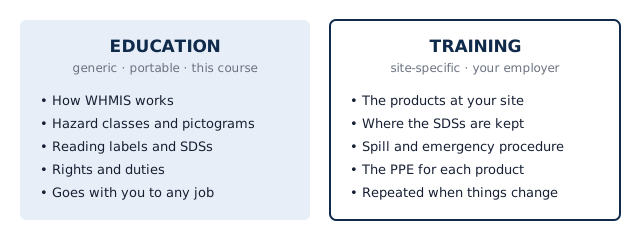
When you change jobs, your education comes with you. Your new employer still has to give you site-specific training before you work with hazardous products there.
Who is responsible for what
WHMIS is a shared responsibility written into federal law (the Hazardous Products Act and Regulations, administered by Health Canada) and into the occupational health and safety law of every province and territory.
Suppliers
Anyone who manufactures, imports, packages or sells a hazardous product for use in a Canadian workplace must classify it, put a compliant supplier label on the container, and provide an up-to-date safety data sheet. Both must be in English and French.
Employers
Employers must make sure every hazardous product that comes into the workplace is labelled, prepare workplace labels when needed, keep current SDSs where workers can reach them, provide education and training, and review the WHMIS program at least once a year or whenever conditions change. They must also keep training records.
Workers
Workers must take part in education and training, use the information to protect themselves and others, follow safe work procedures, use the controls and PPE provided, and report missing or damaged labels, missing SDSs and any hazard they notice.
Supervisors
In most provinces supervisors carry employer-type duties for the people they direct: informing them of hazards, making sure PPE is used, and taking every reasonable precaution for their safety.
Who needs WHMIS education?
Anyone who uses, handles, stores or disposes of a hazardous product, anyone who could be exposed to one during normal work, maintenance or an emergency, and anyone who supervises those people. That covers far more jobs than the obvious ones: cleaners, cooks, hairdressers, dental assistants, farm workers and warehouse staff all handle products with WHMIS pictograms.
What is not covered
Some products are regulated under other laws and are partly or fully excluded from WHMIS: consumer products sold in retail packaging, cosmetics, drugs, food, pesticides, explosives, nuclear substances, and manufactured articles. Hazardous waste is excluded from supplier labelling requirements, but employers must still tell workers how to handle it safely. When a product is excluded, your employer still owes you information about its hazards; the exclusion is from WHMIS paperwork, not from safety.
Knowledge check
Your employer gives everyone this online course and nothing else. Is that enough to meet their WHMIS duties?
Knowledge check
Who is responsible for putting the first label on a container of hazardous product?
Knowledge check
WHMIS 2015 aligns Canada's system with which international framework?
Key points
- WHMIS is Canada's hazard communication system, aligned with the UN GHS since 2015 and updated in December 2025.
- Three parts: labels, safety data sheets, and education plus training.
- Education is portable; training is workplace-specific. You need both.
- Suppliers classify and label; employers keep products labelled, keep SDSs available and train; workers participate, follow procedures and report problems.