Module 6 of 8
Controls, PPE, storage and spills
Knowing a product is hazardous is step one. Step two is reducing the dose that reaches you. This module is about the tools for that, in the order the law and good practice expect them to be used.
The hierarchy of controls
Controls are ranked from most to least effective. Employers are expected to work down the list, not start at the bottom.
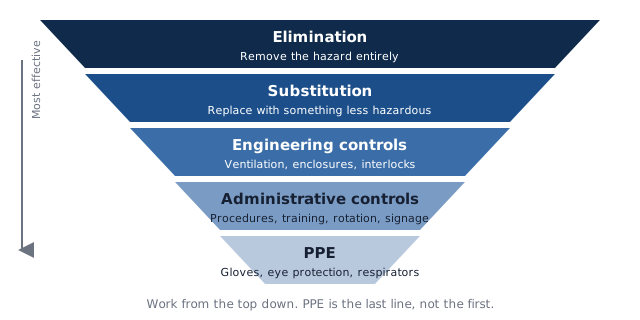
- Elimination. Remove the hazard entirely: stop using the product, change the process so the task disappears.
- Substitution. Replace it with something less hazardous: a water-based cleaner for a solvent, a pellet for a powder, a lower-concentration product.
- Engineering controls. Separate people from the hazard physically: local exhaust ventilation, fume hoods, enclosed processes, closed transfer systems, interlocks.
- Administrative controls. Change how people work: safe work procedures, training, job rotation to limit exposure time, restricted areas, signage and warning systems.
- Personal protective equipment. Gloves, eye and face protection, respirators, protective clothing. The last line, because the hazard is still there; PPE only works while it fits, is worn, and is maintained.
PPE is not a substitute for the controls above it. If you're routinely relying on a respirator to make a task tolerable, the ventilation is the problem, and that is something to raise with your supervisor or the health and safety committee.
Using PPE properly
- Match it to the product. SDS section 8 names the glove material, eye protection and respirator type. Latex gloves do nothing against many solvents; a dust mask does nothing against vapour.
- Inspect before use. Cracked gloves, scratched lenses, a respirator with a worn seal are worse than nothing because they feel protective.
- Fit. Respirators need fit testing; a beard breaks the seal on a tight-fitting mask.
- Remove without contaminating yourself. Peel gloves inside out; wash hands after; don't rub your eyes with a gloved hand.
- Store and replace. Keep PPE clean and away from the chemicals it protects you from; replace it as the manufacturer or your employer directs.
Safe storage
Most chemical fires and uncontrolled reactions start with the wrong things stored side by side. The rules come from SDS sections 7 and 10.
- Keep oxidizers (flame over circle) away from flammables (flame). Bleach and pool chemicals count as oxidizers.
- Keep acids away from bases and away from bleach; mixing bleach with acid or ammonia releases toxic gas.
- Store flammable liquids in approved cabinets, away from ignition sources, in the smallest quantity practical.
- Secure compressed gas cylinders upright with chains or straps; keep valve caps on when not in use; separate fuel gases from oxygen.
- Keep containers closed when not in use; closed containers don't evaporate, spill or absorb moisture.
- Store at or below eye level so you are never lifting a corrosive above your face.
Spills and leaks
Your employer's spill procedure overrides anything general, but the shape is always the same:
- Alert people nearby and your supervisor. If the product is highly toxic, flammable or the spill is large, evacuate the area and let trained responders handle it.
- Protect yourself before approaching: the PPE in SDS section 8, plus ventilation.
- Contain with the absorbent or neutralizer specified in SDS section 6. Never use sawdust on an oxidizer; never wash a spill into a drain unless the SDS says it is safe.
- Clean up and dispose of the waste as the SDS and your employer direct; contaminated absorbent is usually hazardous waste.
- Report the incident so the cause can be fixed. Near misses count.
Exposures and first aid
SDS section 4 gives product-specific instructions. The general rules: for skin and eye contact, flush with running water for at least 15 minutes and remove contaminated clothing; for inhalation, move to fresh air; for ingestion, do not induce vomiting unless the SDS says to; in every case, get medical attention and bring the SDS or product name with you. Know where the eyewash station and emergency shower are before you need them, and check that they are not blocked.
Scenario
A landscaper mixing a concentrated herbicide takes his gloves off to open a stuck cap and splashes his forearm. He rinses for a few seconds, wipes with a rag and keeps working. By evening the skin is blistered. Section 4 of the SDS calls for 15 minutes of flushing and medical attention; section 8 calls for the gloves he removed. Two short reads would have changed the outcome.
Knowledge check
In the hierarchy of controls, which is the LEAST preferred option?
Knowledge check
Which pair of products must NOT be stored together?
Knowledge check
Where do you look for the correct absorbent to use on a spill?
Key points
- Hierarchy of controls: eliminate, substitute, engineer, administer, then PPE.
- SDS section 8 names the exact PPE; inspect it, fit it, and remove it without contaminating yourself.
- Separate incompatibles: oxidizers from flammables, acids from bases and bleach; cylinders secured upright.
- Spills: alert, protect, contain (section 6), dispose, report. Exposures: section 4; flush 15 minutes; get medical attention.