Module 5 of 8
Reading a safety data sheet
The label is the headline; the safety data sheet (SDS) is the full story. Every hazardous product in your workplace must have one, you must be able to get to it quickly, and you should know your way around it before you need it in an emergency.
What an SDS is
A document the supplier prepares that describes the product's hazards, composition, safe handling, storage, emergency response and disposal. Under WHMIS 2015 every SDS uses the same 16 sections in the same order, so once you've read one you can navigate any of them. It must be in English and French and must be kept current: when the supplier learns significant new hazard information, the SDS is updated within 90 days and the employer must obtain the new version.
The 16 sections
Highlighted rows are the ones workers reach for most often.
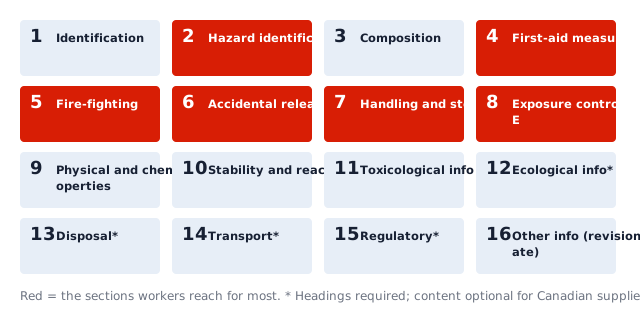
| 1 | Identification — product name (matches the label), recommended use and restrictions, supplier contact, emergency phone number |
|---|---|
| 2 | Hazard identification — classification, signal word, pictograms, hazard and precautionary statements. The label information, in one place. |
| 3 | Composition / information on ingredients — chemical names, CAS numbers and concentrations of hazardous ingredients |
| 4 | First-aid measures — what to do for each route of exposure; symptoms; whether to seek medical attention |
| 5 | Fire-fighting measures — suitable extinguishing media, special hazards (toxic combustion products), protective equipment for firefighters |
| 6 | Accidental release measures — personal precautions, containment and clean-up for spills and leaks |
| 7 | Handling and storage — safe handling practices, incompatible materials, storage conditions |
| 8 | Exposure controls / personal protection — exposure limits, engineering controls, and the specific gloves, eye protection and respirator to use |
| 9 | Physical and chemical properties — appearance, odour, pH, flash point, boiling point, vapour pressure and more |
| 10 | Stability and reactivity — conditions to avoid, incompatible materials, hazardous decomposition products |
| 11 | Toxicological information — routes of exposure, symptoms, acute and chronic effects, test data |
| 12 | Ecological information* |
| 13 | Disposal considerations* |
| 14 | Transport information* — TDG / UN number and shipping classification |
| 15 | Regulatory information* |
| 16 | Other information — including the date the SDS was prepared or last revised |
* Sections 12 to 15 must be present with their headings, but Canadian suppliers are not required to fill them in. Everything else is mandatory.
How to use it in practice
- Before first use: read sections 2, 7 and 8. Know the hazards, how to store it, and exactly which PPE the supplier specifies. "Wear gloves" is not enough; section 8 names the glove material.
- In an emergency: go straight to section 4 (first aid), 5 (fire) or 6 (spill). Tell emergency responders the product name from section 1.
- Checking currency: section 16 shows the revision date. Products are reformulated; a sheet more than a few years old deserves a call to the supplier.
- Matching: the product identifier in section 1 must match the label on the container. If it doesn't, you may have the wrong sheet or the wrong product.
Where SDSs are kept
Employers must keep an SDS for every hazardous product in the workplace and make it readily available to workers and the health and safety committee or representative. "Readily available" means you can get to it without asking permission and without delay, close to where the product is used: a binder on the floor, a terminal with no password wall, or a phone app, so long as it works during a power failure or an emergency. Ask where yours are on your first day; it is part of the workplace-specific training your employer owes you.
Scenario
An apprentice mechanic has used a brake cleaner for months with bare hands. His supervisor, doing the annual WHMIS review, pulls the SDS. Section 8 calls for nitrile gloves and specifies adequate ventilation; section 11 lists skin absorption and central-nervous-system effects. Nothing has changed about the product. What changed is that somebody read the sheet.
Knowledge check
A co-worker has splashed a cleaning product in her eye. Which SDS section do you go to first?
Knowledge check
Where on an SDS do you find the specific type of gloves and respirator to use?
Knowledge check
How many sections does a WHMIS 2015 safety data sheet have?
Key points
- Every hazardous product needs a current SDS, readily available to workers, in both official languages.
- 16 sections, fixed order. Workers use 2, 4, 5, 6, 7 and 8 most; 16 has the revision date.
- Section 8 specifies the exact PPE; read it before first use, not after the spill.
- Product name on the SDS must match the label.