Module 2 of 8
How chemicals harm the body
Labels and data sheets only make sense once you understand what a chemical can actually do to you. This module gives you the vocabulary: the forms a hazardous product can take, the four ways it gets into your body, and why "how much" and "how long" change everything.
Six physical forms
A product's state on the shelf isn't always its state in the air you breathe. Work processes change it.
| Form | What it is | Typical sources |
|---|---|---|
| Gas | Occupies the whole space it is in at room temperature | Propane, carbon monoxide, chlorine, oxygen |
| Vapour | The gas form of something that is normally a liquid or solid | Solvent vapour from paint, thinner, cleaning products |
| Mist | Tiny liquid droplets suspended in air | Spray painting, cutting-oil mist, pressure washing |
| Dust | Solid particles created by grinding, cutting, sanding or pouring | Wood dust, silica from concrete, flour, metal grinding |
| Fume | Very fine solid particles formed when vaporized metal or plastic cools | Welding, soldering, plastic overheating |
| Smoke | Particles and droplets from burning carbon-based material | Fires, diesel exhaust |
The practical point: a solid in a tub is low risk until a grinder turns it into dust you can inhale; a liquid in a drum is low risk until a sprayer turns it into mist.
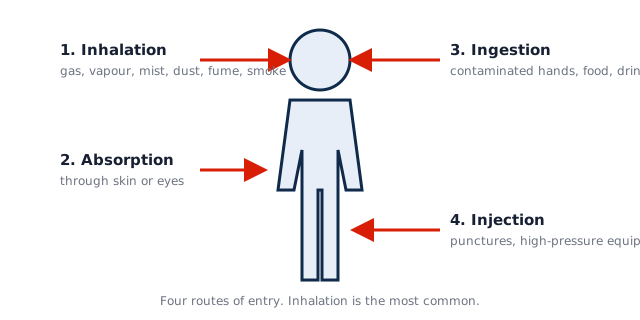
Four routes of entry
Inhalation
Breathing it in. This is the most common route, because all six forms above can be inhaled. Some products damage the airways and lungs directly; others pass through the lungs into the bloodstream and travel to the liver, kidneys, brain or nervous system.
Absorption
Through the skin or eyes. Skin is a barrier, but many solvents, pesticides and some metals cross it, and cuts, cracks or dermatitis make it easier. Absorption can cause local damage (burns, rashes) or systemic effects once the chemical is in the blood.
Ingestion
Swallowing. Rarely deliberate; usually from contaminated hands, food or drink, or from particles cleared from the airways and swallowed. This is why eating, drinking and smoking are banned where hazardous products are used, and why hand washing matters.
Injection
Through a puncture or cut. High-pressure equipment (grease guns, hydraulic lines, pressure washers) can inject fluid through intact skin. Contaminated sharps are the main concern in health care and waste handling.
Scenario
A countertop installer dry-cuts quartz slabs in a small shop for most of a shift. Nobody is spraying anything, there are no strong smells, and the dust settles quickly. He has no symptoms that day. The product is in a solid form that looks harmless, but cutting created respirable silica dust, inhalation is the route, and the effect, silicosis, is chronic: it shows up years later and cannot be reversed.
Dose: how much, how often, for how long
Every substance can harm you at a high enough dose, and almost none harms you at a low enough one. The dose is set by concentration (how much is in the air or on your skin), duration (how long you're exposed) and frequency (how often). Two workers using the same product can have very different exposures depending on ventilation, PPE and work habits. That is why the same chemical can be safe on one site and dangerous on another, and why your employer's site-specific training matters.
Three kinds of health effect
- Acute effects appear immediately or within hours of a single, usually high, exposure: a chemical burn, dizziness from solvent vapour, collapse from carbon monoxide. Often treatable if caught quickly; sometimes fatal.
- Chronic effects develop from repeated or long-term exposure, often at low doses: dermatitis, occupational asthma, liver damage, cancer. They are usually discovered only after significant damage and are often irreversible.
- Latent effects have a delay between exposure and symptoms, sometimes decades. Asbestos-related disease and some cancers are the classic examples. The exposure may be long forgotten by the time the illness appears.
Effects can also be local (at the point of contact: skin, eyes, airways) or systemic (after the chemical has entered the blood and reached an organ elsewhere). The health-hazard sections of an SDS tell you which to expect.
Knowledge check
Which route of entry applies to the most physical forms of hazardous product?
Knowledge check
A cleaner develops cracked, itchy skin on her hands after two years of using a degreaser without gloves. This is best described as:
Key points
- Processes change a product's form: cutting makes dust, spraying makes mist, welding makes fume.
- Four routes of entry: inhalation (most common), absorption, ingestion, injection.
- Dose = concentration × duration × frequency. Controls and PPE reduce dose.
- Acute effects are immediate; chronic effects build up; latent effects appear long after exposure.